Calpe and Benidorm are the obvious choice: solid infrastructure, beaches everyone already knows, everything within reach. But drive 20 to 40 minutes along the coast or inland, and a different Costa Blanca opens up — one that rarely makes it into the standard listicles. Not because there’s nothing to see, but because no tourism industry has been built there for mass volume, which means no crowds, no queues at the door, and no five-language menus with photos of every dish. If you’ve already done Calpe, or just want a day away from dense resort development, here are five destinations worth getting in a car for.
Jávea: a town without high-rises
Half an hour north of Calpe, Jávea (Jávea/Xàbia) deliberately keeps its buildings low — local rules rarely allow more than a few storeys, so the coastline here never turned into a wall of hotels the way it did in neighbouring resorts. The town effectively has three centres: Arenal, a pebble beach with a promenade, restaurants and an evening paseo; the historic port with fishing boats and squat old warehouses; and the old town on a hill a couple of kilometres from the sea, which tourists rarely reach. Up there stands the Gothic fortress-church of San Bartolomé, built from dark stone — in the Middle Ages it doubled as both a place of worship and a refuge from pirate raids, which is why its lower walls are so massive and windowless. A separate reason to come to Jávea is Cape San Antonio, with its lighthouse and sheer drop to the sea: the viewpoint there is far less crowded than comparable spots in Calpe, and the view of the cliffs and turquoise water is every bit as good.
Moraira: a small harbour instead of a resort
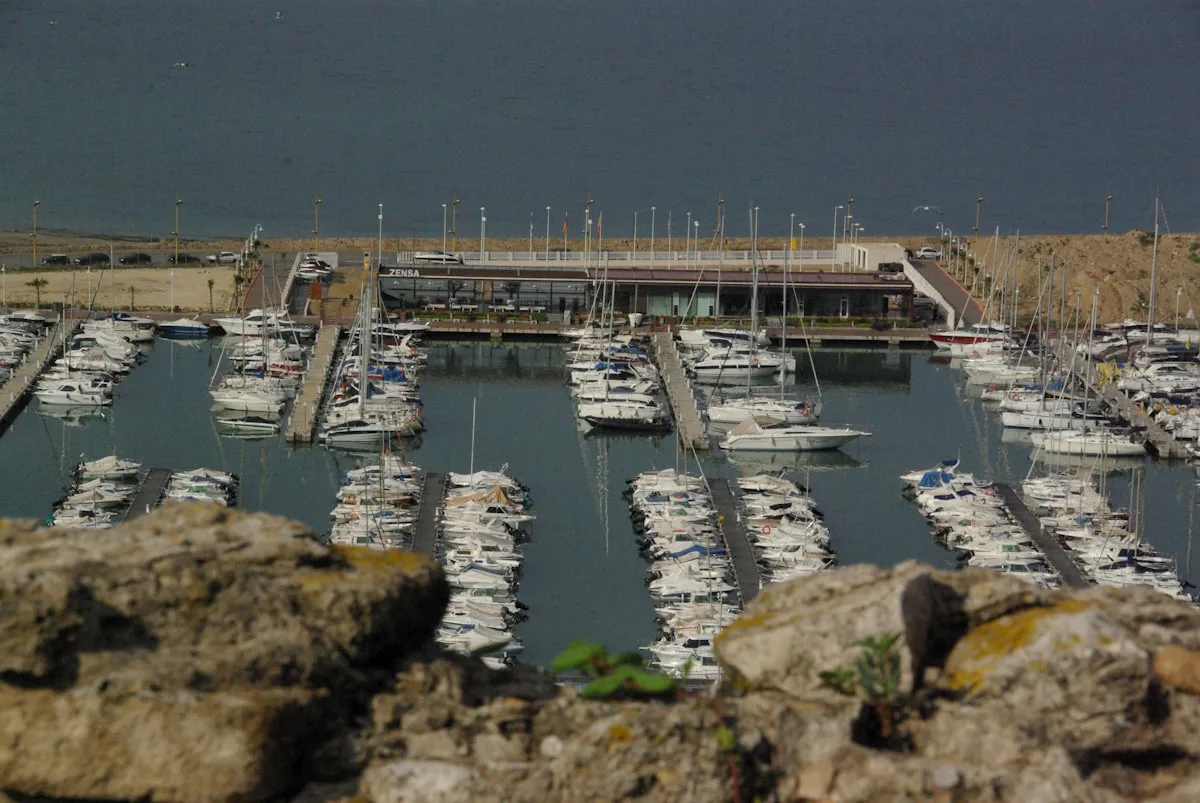
Moraira is roughly what Calpe might look like today if building height had never been allowed to rise above a two-storey villa. There isn’t a single high-rise here — just private houses scattered across pine-covered hills and a small fishing marina where the catch is still unloaded and nets mended most mornings, not for atmosphere but because fishing here is still an actual trade, not a prop. El Portet beach, a small enclosed cove with clear water between two rocky headlands, is worth seeing precisely for the quiet: there’s physically no room for a crowd, parking is limited, and that keeps the flow of people natural rather than managed. In the evening, family-run restaurants on the seafront serve fish caught that same day rather than trucked in from a wholesale warehouse — and it usually costs less than it would in the tourist quarters of the bigger resorts.
Dénia: ferry, castle and market
Dénia is bigger than Jávea and Moraira and noticeably livelier — ferries leave from here for Ibiza and Formentera, so the port has genuine maritime traffic: cargo terminals, ferry berths and a fishing fleet, not just the leisure yachts you’ll find in the neighbouring marinas. Above the town, on a rocky hill, stands Dénia Castle, a fortress with centuries of history that was rebuilt in turn by Romans, Moors and the Spanish crown; it’s worth the climb for the panorama alone, which takes in the whole coastline as far as Montgó. At the foot of the castle is the old town, with narrow streets and a market, and down at the port itself a fish auction runs on weekday mornings: the fresh catch goes up for sale to wholesalers straight off the boats, bidding happens in real time, and it’s worth stopping to watch even if you’re not buying anything.
Altea: an old town on a hill
Altea sits south of Calpe, between it and Benidorm, but in character it’s an entirely different town. Whitewashed houses climb the hill toward a church with a blue-and-white domed roof that has become something of a postcard image for the whole coast, and the streets are so narrow and tangled that tour buses simply can’t get in. It’s a town of artists: painters and craftspeople have been settling here since the 1960s, and to this day small galleries, ceramics workshops and shops with no English signage open in the old centre each evening. From the square by the church, the view over the bay is one that locals and guidebooks alike often rank among the best sunsets on the whole coast — and unlike the viewpoints in Calpe, you rarely have to wait your turn for a photo.
Guadalest: a mountain village for a change of scenery
If you want to get away from the sea entirely for a day, Guadalest is the classic choice: a mountain village about 40 minutes from Calpe, wedged between a sheer cliff and a reservoir of deep turquoise water. The only way into the old part of the village is through a tunnel cut straight into the rock; beyond it stands the Castell de Sant Josep at the very top, along with the remains of the fortress walls and a view over a valley where mountains and terraced orange groves stand in for the sea. It’s a completely different Spain with no beach in sight, which is exactly why it works so well as a contrast. The village itself is compact and takes only a couple of hours to see, so it’s easy to combine the trip with a stop in Altea on the way there or back.
None of these places make it onto the list of popular routes on the site — that page covers the most common requests, like the Alicante–Calpe transfer. That doesn’t mean we don’t drive there, though: custom transfers exist for exactly this kind of trip, when the route you want isn’t on the standard list. Message us on WhatsApp or Telegram with your destination and time, and we’ll send an exact price and confirm the car within 5 to 10 minutes — the same as through the booking page.